








From Transistors to Silicon: The Rise of Hong Kong’s Electronics Industry

If plastic flowers were the most colorful chapter of Hong Kong’s industrial golden age, electronics assembly lines were the quietest — and the one whose influence carried the farthest. In 1959, a transistor radio came off an assembly line in Kwun Tong; just three years later, an American semiconductor company from Silicon Valley wrote the opening chapter of Asia’s semiconductor-assembly history inside a former rubber-shoe factory in Kowloon Bay. This story never captured the public imagination the way plastic flowers did, but it quietly laid down a path — for Hong Kong, and eventually for all of Asia — from contract assembly toward precision manufacturing. Looking back today, these forgotten episodes scattered across the industrial buildings of Kwun Tong and Kowloon Bay are perhaps the most easily overlooked glimmer in Hong Kong’s industrial heritage.
It Started with a Transistor Radio
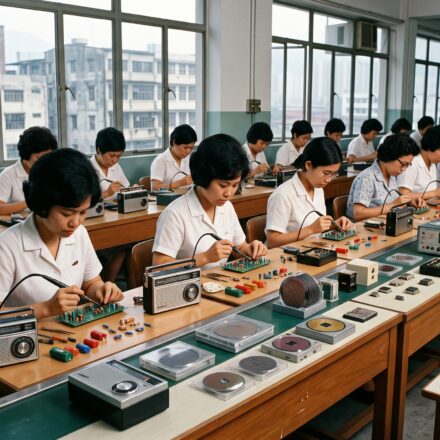
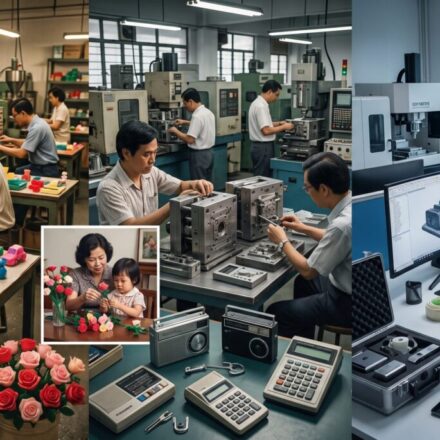
Around the time Hong Kong Commercial Radio went on air in 1959, a locally founded radio factory operating under a manufacturing contract with Sony began operations in Hong Kong, producing transistor radios — known colloquially at the time as “atomic-particle radios” — at a rate of roughly four thousand units a month. The technical barrier to entry was low: a handful of workers could assemble hundreds of radios a day, precisely meeting the world’s urgent demand for cheap consumer electronics. The market responded faster than anyone expected: Hong Kong had just three radio factories in 1960, twelve by the following year, and fourteen by 1962.
For an ordinary working-class family at the time, a radio was still something of a luxury. But for Hong Kong’s industry as a whole, these modest assembly plants marked the starting point of what would eventually become a global hub for electronics contract manufacturing.
Fairchild Semiconductor and the Leap Forward in Assembly
The real turning point came in 1962. Fairchild Semiconductor, an American semiconductor company, leased space in a former rubber-shoe factory on Hang Yip Street in Kowloon Bay, registered a local company, and began full production the following year. The silicon wafers were still manufactured in California, then shipped to Hong Kong for final assembly and testing — some finished products were sent back to the United States, while the rest were sold directly into Asian markets. Hong Kong’s low labor costs actually allowed Fairchild to hire more experienced engineers to oversee the production line, keeping product quality high. In its very first year of operation, the Hong Kong plant assembled roughly 120 million semiconductor components.
Fairchild’s Hong Kong plant began production well before Taiwan, South Korea, and Singapore — all of which later became famous for semiconductor contract manufacturing in their own right — making it one of Asia’s earliest offshore semiconductor assembly bases.
This step carried enormous significance. For the first time, Hong Kong industry wasn’t simply copying the appearance of foreign products — it was plugging directly into the tail end of the production chain for the world’s most cutting-edge technology sector. Assembly, testing, quality control — these seemingly basic tasks became Hong Kong workers’ first point of contact with the world’s most advanced technology.
Craft in Hand: Female Workers, Apprenticeship, and Quality as a Competitive Edge
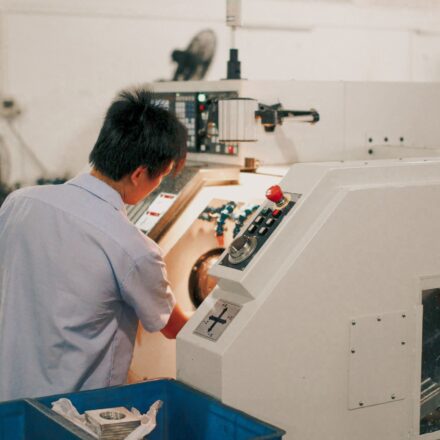
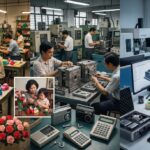
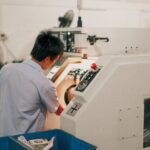
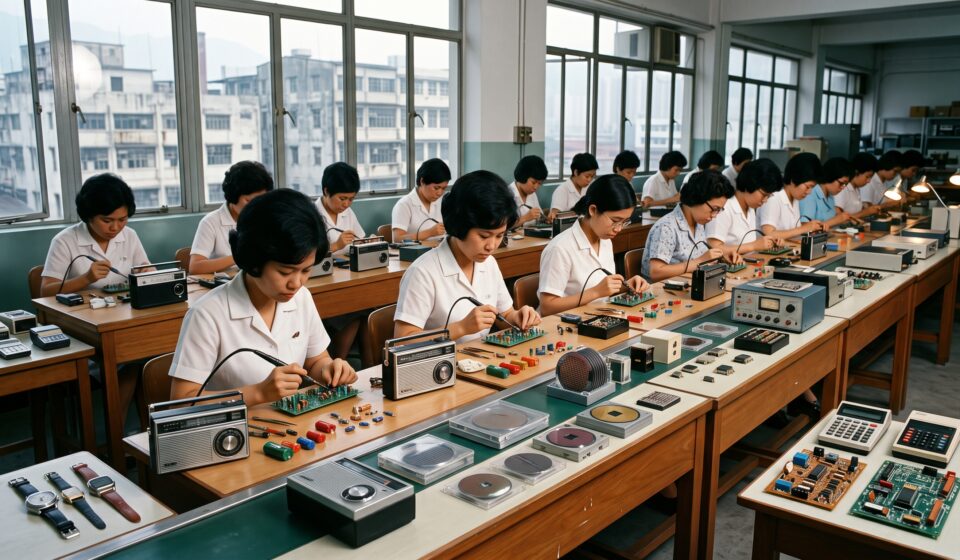
The expansion of electronics assembly gave rise to an entire generation of skilled female technical workers. In the industrial buildings of Kwun Tong and Kowloon Bay, thousands of women worked assembly lines soldering, wiring, and testing components, and their deep familiarity with component behavior gradually became a core competitive strength of Hong Kong manufacturing. This kind of expertise couldn’t be built overnight — most factories relied on an apprenticeship system, passed down by word of mouth, with experienced workers guiding newcomers and gradually building up a shared, localized understanding of quality control.
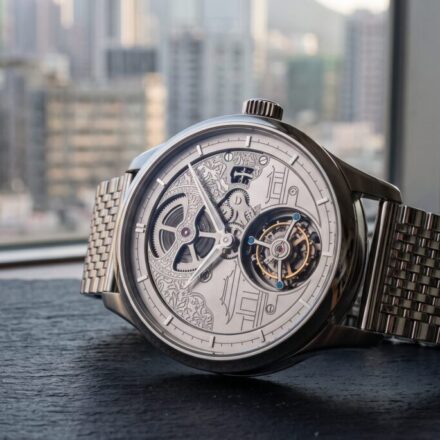
By the 1970s, this accumulated assembly experience began extending into higher-value products — electronic watches, calculators, and electronic toys all became major Hong Kong exports in turn, with the city’s watch and clock industry growing into one of the largest by export value in the world. Electronics went on to become Hong Kong’s single largest export-earning industry, a position it has held ever since.
Finding an Echo Amid Global Transformation
By the late 1980s, as rents and wages continued to climb, large numbers of electronics assembly lines began relocating north to the Pearl River Delta. In late 1978, a heating-coil factory established as a joint venture between Shenzhen’s Shek Ngan Sheung Uk production brigade and Hong Kong investors became the mainland’s first “three-plus-one” processing enterprise, marking the beginning of this migration — Hong Kong businesspeople carried their capital, technology, and management experience across the border, effectively recreating the assembly-line path Hong Kong itself had once followed.
This shift wasn’t just a geographical relocation — it marked a change in Hong Kong’s own role, moving from direct production toward supply-chain management, design and R&D, and brand operation. Although large-scale assembly lines moved away, the engineering-management expertise and deep familiarity with global supply chains that Hong Kong had built up didn’t disappear along with them — instead, they carried on in another form. Today, Hong Kong is still home to several local firms focused on chip design, holding their own in niche fields such as display drivers and audio chips, carrying forward the technical lineage that traces all the way back to those assembly lines in Kwun Tong.
From a single transistor radio, to a piece of Fairchild silicon, to the chip-design teams working in offices today, the story of Made in Hong Kong was never about winning through sheer scale — it was about the resilience to find a precise foothold and adapt quickly in the face of scarce resources. That quiet glimmer may be the most fitting key to understanding Hong Kong’s industrial heritage.

Chief Editor, MIHK Focus
Directing editorial research on Hong Kong’s industrial history, heritage brands, and modern manufacturing trends. Focused on delivering structured observations, market insights, and archive-backed narratives on local production and commercial dynamics.
Follow Me